what chemical in sunscreen is harmful to the environment
/https://tf-cmsv2-smithsonianmag-media.s3.amazonaws.com/filer/a0/da/a0dab890-ac15-4e93-b4a2-9ea874c78730/istock-540384610.jpg)
Earlier this calendar month, Hawaii banned sunscreen. Not all sunscreen—just the kind containing the active ingredients oxybenzone and octinoxate—but that encompassed about of the major brands, from Banana Boat to Coppertone. The reason for this seemingly perverse law, which goes into effect in 2021, was recent inquiry confirming that the lotion we slather on to protect our skin tin also do grave harm to the globe's coral reefs.
The Hawaiian ban was based on a 2016 report by Craig Downs and colleagues at the Haereticus Ecology Laboratory, which showed that these ii chemicals were to blame for slowing coral growth and increasing the rate of coral bleaching. (Bleaching happens when weather similar temperature change so dramatically that corals turn completely white and the symbiotic algae living in their tissues flee their homes.) In February, Downs told The New York Times that sunscreen and other chemical wash-off through showering and pond plays a bigger role than climate change in damaging coral reefs.
But just how conclusive the evidence on sunscreen'south impact on coral reefs—and whether consumers should switch to "reef-friendly" sunscreens—remains disputed. According to marine ecology researcher Cinzia Corinaldesi, who has studied the bear on of sunscreens on coral reefs since 2003, the problem is that "unfortunately, oxybenzone is not the only harmful ingredient of sunscreens." Other UV filters, including zinc oxide, are proving to have an impact on coral bleaching—and the ban does zippo to preclude these.
There are 2 kinds of sunscreen ingredients on the market, which work in different means. Physical sunscreens, besides called mineral or inorganic, block or reflect both UVA and UVB rays; zinc oxide and titanium dioxide are the 2 well-nigh common concrete sunscreen ingredients. On the other hand, chemical, or organic, sunscreens, which typically include oxybenzone, octinoxate, avobenzone and PABA equally ingredients, absorb and reduce UV rays' ability to penetrate the skin. Some sunscreen formulas include both kinds of sunscreen actives.
The mounting research on the impact of sunscreen on coral reefs and marine environments is more important than e'er, says analytical environmental pharmacist Felix R. Roman-Velazquez, a professor at the University of Puerto Rico at Mayaguez and ane of the researchers behind a new experiment to remove oxybezone from bodies of water. "By 2020, over one billion people effectually the world will be visiting oceans for recreation and tourism," he says. "We're talking near lots of sunscreen that is going to be dumped into the ocean."
While it's unclear to what extent exactly bleaching actually affected by sunscreen compared to other factors, an estimated 6,000 to 14,000 tons of sunscreen become into coral reef areas each year. And this is enough, says Corinaldesi, to make an bear on.
She would know. In 2008, Corinaldesi and her colleagues the Polytechnic University of Marche in Ancona, Italian republic, found that three individual chemical, or organic, sunscreen ingredients—oxybenzone, butylparaben and octinoxate—tin can bleach coral reefs. Considered the commencement scientific evidence on the impact of sunscreens on coral reefs, the study confirmed what some scientists and locals had witnessed: that swimmers, surfers and divers in popular beach destinations were affecting marine ecosystems. On the Yucatan coast in Mexico, for example, resort managers had noticed living species were dying off in enclosed pools known as cenotes where people regularly swam.
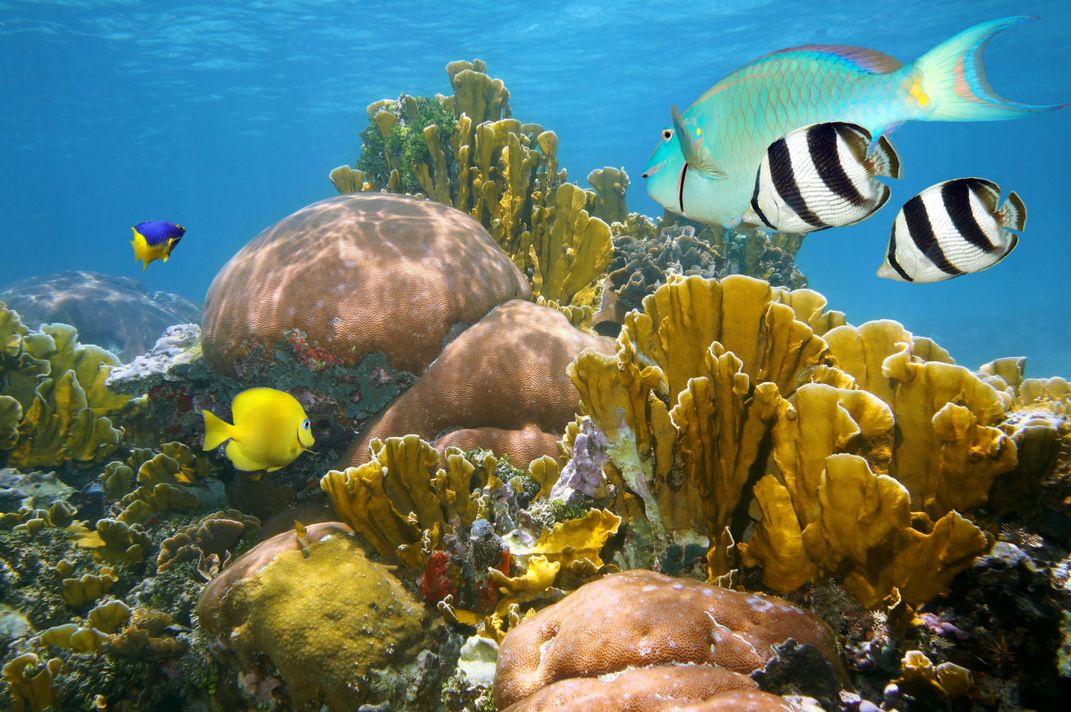
Since the 2008 study, the evidence suggesting chemical, or organic, sunscreen negatively impacts coral reefs has only gotten stronger. And yet organic filters like oxybenzone still boss the sunscreen market. That's largely because the culling—mineral or concrete sunscreens containing ingredients like zinc oxide and titanium dioxide—go out behind a heavy white cast that can look ghostly on people with darker pare, and they're often greasier and tougher to alloy in.
But given the bear witness, at that place has been a push in contempo years for "reef-friendly" alternatives. While these options, typically in the form of mineral sunscreens, have been considered safer, more environmentally friendly in the media, some new enquiry has suggested that's non the instance. Since 2009, Corinaldesi has been putting these "reef-friendly" ingredients to the test. She has proved, along with other researchers, that some mineral sunscreens and those marketed as "eco-friendly" are no safer for coral reefs than chemical ones.
Confirming previous inquiry, Corinaldesi and her team found in a newly published study that zinc oxide causes astringent coral bleaching, damaging hard corals and their symbiotic algae. "Our studies point that zinc oxide nanoparticles are very harmful for marine organisms, whereas titanium dioxide with surface coatings and metal doping, have a much lower bear on," she says. "Unfortunately, despite several cosmetic products and sunscreens bachelor in the market are divers 'reef-safe' or 'eco-friendly' or 'biodegradable,' they are not then, and indeed lack specific tests on marine organisms."
Just not everyone believes the evidence is and so articulate-cut. Seemal R. Desai, a clinical assistant professor of dermatology at the University of Texas Southwestern Medical Eye, says there aren't enough big-scale trials to suggest that the connection betwixt sunscreen and coral reef harm is absolute. "In that location are some small studies that take shown potentially some association with chemical sunscreen [to damage to coral reefs]," he says. "However, we don't accept enough information to say that for certain. And so I'm very cautious to buy into the argument most sunscreen causing environmental impairment."
A review of inquiry on studies related to sunscreen and coral reefs by the International Coral Reef Institute suggests that further research is needed. "To date, experiments have largely been undertaken exsitu and in that location are concerns that they may not properly reverberate atmospheric condition on the reef, where pollutants could be apace dispersed and diluted," the written report states. For case, the report states, concentrations of sunscreen chemicals used in some research work accept been higher than those in real coral reef environments. This may skew the perceived impact of reef harm.
Desai is concerned that Hawaii's ban "may be sending the wrong message that sunscreens aren't [safe] for use, and I recollect that's really unsafe." A trade association for sunscreen companies as well warned in a statement that the ban is putting people at gamble of skin cancer. Any environmental damage acquired past sunscreen is no excuse to skimp on the sunscreen, given the culling, Desai warns: "At that place is no denying the link between UV rays and skin cancer, and so not wearing sunscreen would certainly exist harmful to the private patient."
A review of sunscreen research published this month in the Journal of the American Academy of Dermatology besides concludes there's non plenty testify to advise certain sunscreen ingredients are harmful to the environment.
Dermatologists suggest people should wear sunscreen on a daily basis considering UVA rays (which penetrate deep into the skin) and UVB rays (which burn the superficial layers) tin can wreak havoc on our skin, and they can both directly contribute to pare cancer. In fact, 1 in five Americans volition develop skin cancer by the historic period of 70, according to the Pare Cancer Foundation. Most skin cancers are caused by the sunday, and some are deadly.
For consumers both interested in protecting their pare from dominicus damage and protect the surroundings, what'southward the right choice?
.....
Unfortunately, right now there aren't many alternatives on the market. I of the reasons is that, since it claims to prevent skin cancer, sunscreen is considered a drug by the Nutrient and Drug Administration, pregnant the procedure for approving sunscreens is more than rigorous than other cosmetics. There are but 16 FDA-canonical agile sunscreen ingredients, and only a scattering of those are commonly used, so the choices are limited.
The last time the FDA approved a new sunscreen active ingredient was in the 1990s, and currently, 8 new ingredients are pending blessing. Past dissimilarity, the European Union allows nearly xxx agile sunscreen ingredients.
Sandy Walsh, a spokesperson for the FDA, says the agency is working on reviewing additional sunscreen active ingredients as required by the Sunscreen Innovation Act, a 2014 law that was supposed to expedite up the process of over-the-counter sunscreen approvals. "[Nosotros're] doing our part to provide consumers with safe and effective sunscreen formulations," says Walsh. "To exist successful, we need industry'south aid, and they need ours. That'southward why we've also been meeting with manufacturers to discuss sunscreen data recommendations and why we have issued relevant guidance to help them."
An effort called the Public Access to SunScreens Coalition has also been working to improve and accelerate the FDA process for new ingredient approval since 2012. Only for the time being, the group says Hawaii's ban is detrimental without viable replacements. "A ban on these ingredients without adequate, FDA-approved alternatives and without extensive research demonstrating that this action is needed to properly residual environmental affect with the risk to public health from inadequate UV protection is premature," the group said in a letter of the alphabet to Hawaii governor David Y. Ige earlier the legislation was signed into law.
This sentiment has as well been echoed past the Skin Cancer Foundation, which said in a printing release that "the legislation in Hawaii emphasizes the need for new sunscreen ingredients and should send a message to the FDA."
Especially given the most recent study on zinc oxide, Sachleben points out that there aren't any sunscreens proven to be safe to coral. "The most condom [option] is UV-protective clothing for utilise in the water. Right now that's the simply thing that has a expert sun-blocking capability and minimal touch on coral."
Merely y'all can't rely just on dominicus-protective clothing, Desai notes. "Sunday-protective wear does not replace sunscreens," he says. Later all, some skin cancers, like basal and squamous prison cell, happen most often on the face, arms and necks—areas exposed to the sun and which are not always easy to cover up with clothing, especially on the beach.
.....
In the meantime, scientists are working on a few possible solutions. One inquiry team from the College of Pharmacy at the University of Florida is working on creating a "natural sunscreen" from shinorine, a UV-absorbing ingredient harvested from algae.
Another team in Puerto Rico is working to create biodegradable beads that could soak upwardly oxybenzone from oceans, every bit highlighted in Popular Science . The moment you pace into the ocean, the oxybenzone you lot've slathered on your pare begins to seep into the waters around yous. It doesn't take long for it to build upwards to dangerous levels, the researchers reported final summertime at the American Chemical Gild national meeting.
The absorbent beads Roman-Velazquez and his team have created are a chip bigger than poppy seeds. Made from materials derived from algae and chitin, the chaplet would take near a month to completely disintegrate. In testing the chaplet for oxybenzone, they were able to remove 95 per centum of the contamination within one 60 minutes. In theory, the beads could be used in conjunction with other efforts in loftier-tourism areas. "Later people bathe in the beach all day, nosotros can probably develop a process where we have a boat and drag these chaplet effectually [within a net] before [the chemicals] wash toward the corals," Roman-Velazquez says.
Corinaldesi says any efforts to reduce the impact of sunscreen on coral reefs are a motility in the right direction. "I appreciate the work done by these scientists to develop new systems to make clean up marine water from the oxybenzone for the conservation of tropical reefs," she says. "This is a first and important step forward to reduce the touch of oxybenzone in marine systems."
And while their inquiry—which they promise to publish as early as this year—has focused on oxybenzone, Roman-Velazquez says his team is hoping to test other sunscreen ingredients for future studies. He adds that w hile neither his team'southward beads nor Hawaii'southward ban offers a uncomplicated solution to clear the corals of damage, it's an important measure. "Tourism is so large in Hawaii, so they should exist concerned near protecting those resources," he says.
bergeronskeethe1937.blogspot.com
Source: https://www.smithsonianmag.com/science-nature/scientists-are-unraveling-new-dangers-sunscreen-coral-reefs-180969627/
0 Response to "what chemical in sunscreen is harmful to the environment"
Publicar un comentario