How to Get to Michael C Rockefeller Arts Center at Fredonia College
How The Vanderbilt Family Lost Their Entire Fortune
In the belatedly 19th century, social and technological changes immune thousands of families to get ridiculously rich and prosper in a menstruum called the Gilded Age, equally described past Fourth dimension. Information technology was an era where flaunting your wealth publicly was all the rage, even in the face of income inequality every bit millions of other Americans struggled day to day. The Gilded Age was when many of the infamously wealthy families got their starting time, from the Rockefellers to the Carnegies to the Vanderbilts (via ThoughtCo). Merely while their legacy is still recognizable today, with their names plastered on universities and cultural landmarks, for many, their fortune has been gone for some time now.
The Vanderbilts, owners of a railroad empire brought to the top by ruthless patriarch Cornelius "the Commodore" Vanderbilt, were once the richest family on the planet. As told by descendant Arthur T. Vanderbilt 2 in his volumeFortune's Children: The Fall of the Firm of Vanderbilt , not even 30 years after his decease in 1877, the Vanderbilt family had fallen off the list of the wealthiest families in the United States. Less than a century later, in 1973, when 120 Vanderbilts came together for a family reunion at Vanderbilt University, in that location wasn't a unmarried millionaire in attendance.
Then how does a family go from being one of the richest alive to having piffling affect in simply a few generations? Here'due south how the Vanderbilt family unit lost their entire fortune.
Information technology takes "a man of brains" to agree onto a fortune
Hulton Annal/Getty Images
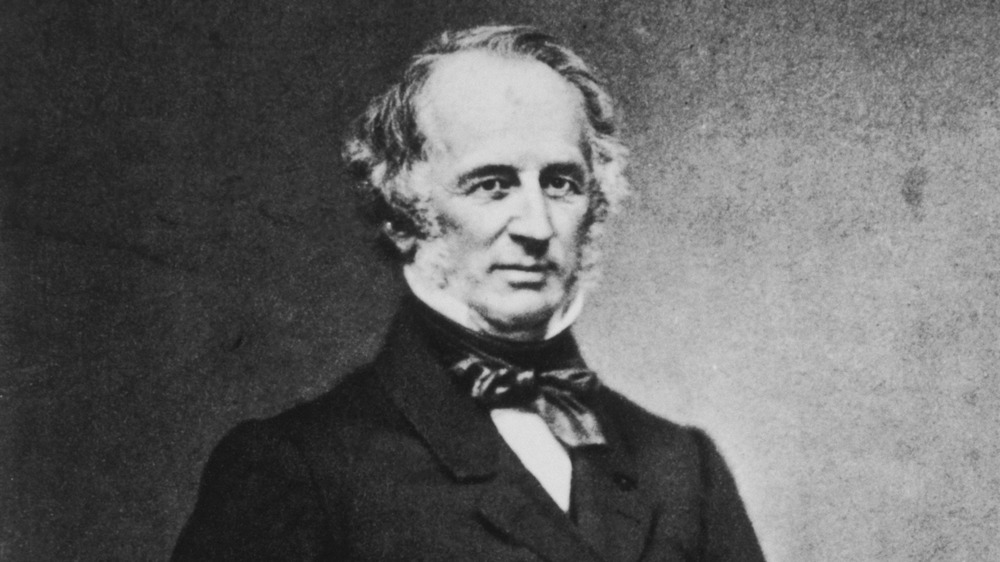
Part of a New York farming family of modest means, Cornelius "the Commodore" Vanderbilt was 16 when he borrowed $100 from his mother in exchange for plowing eight acres of soil, according to Encyclopedia.com. The year was 1810, and the $100 (equivalent to a petty over $2,100 today, per the Official Data Foundation) was spent on a boat that he used to first his own send and freight business.
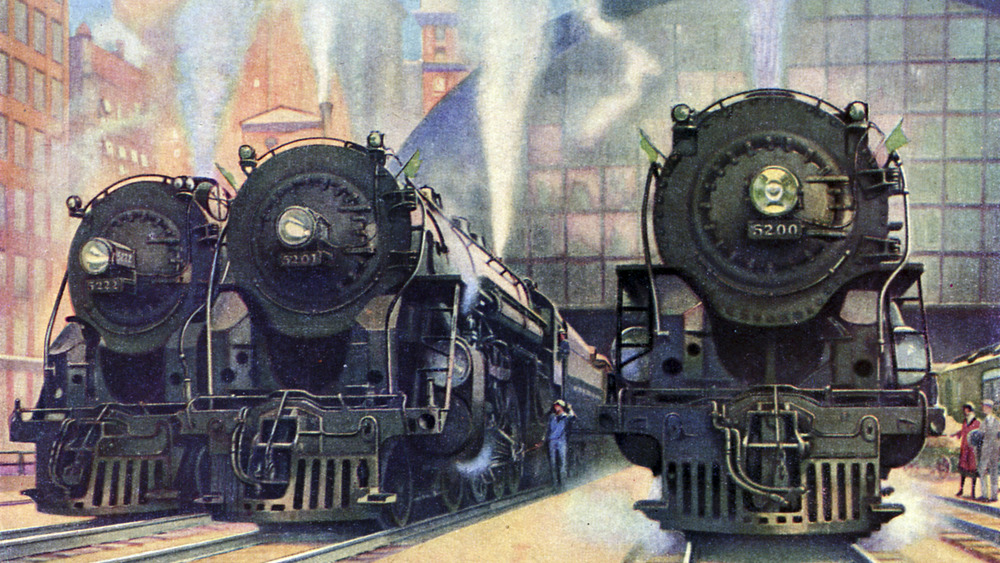
Over fourth dimension, the Commodore moved on to invest in steamships and and then railroads, and earlier he knew information technology, he had built upwards the shipping and railroad empire New York Central and get the richest American. At the fourth dimension of his expiry in 1877, his fortune was valued at $100 one thousand thousand (equal to nearly $2.5 billion today, via the Official Data Foundation), which was more money than was held in the U.Southward. Treasury at the time, according to Forbes.
The Commodore is said to accept told his oldest son, William Henry "Billy" Vanderbilt, "Whatever fool tin can make a fortune; it takes a man of brains to agree onto it." Baton took the advice to heart and doubled the family fortune before his death in 1885, but his own descendants would dwindle it all abroad in just a few decades.
The Commodore's passion for business organisation didn't run in the family
As written by Arthur T. Vanderbilt II inFortune's Children: The Fall of the Firm of Vanderbilt, despite the Commodore's great success as a businessman and investor, the human was notoriously harsh and rarely trusted his family with his business and coin. His 8 married daughters were ignored since they no longer bore the family proper name, but, of form, that was simply i factor that barred his daughters from taking over the business. In one case, afterwards a daughter sold her firm and asked him to invest the coin for her, the Commodore doubled information technology and then refused to return her coin dorsum. "Women are non fit to have money anyway," he said.
By the time of his death, merely two of the Commodore's sons were alive, and only the elderberry, William "Billy" Vanderbilt, had the skills to handle the family concern and fortune. The younger, Cornelius "Corneel" Vanderbilt II, was wildly irresponsible and had congenital upwards and then much debt that the Commodore refused to see him fifty-fifty on his deathbed.
Rather than instruction his children his business skills, the Commodore often left them on their own until they could prove themselves to him. Even Billy, who ended upward being the primary inheritor of the Vanderbilt fortune, wasn't allowed to go experience within the railroad empire until he was in his forties. Perhaps it's not that surprising, then, that the future Vanderbilts were unprepared to handle the family fortune.
Money brought "nothing but anxiety" for Billy Vanderbilt
Culture Lodge/Getty Images
When his father passed in 1877, his eldest son William "Billy" Vanderbilt inherited the bulk of his manor, including the 87-pct pale in New York Central, according to Forbes. While Baton was able to bear witness his concern sense to his father, information technology would exist a error to assume that the 2 men had similar characters. As told by Arthur T. Vanderbilt Two, the begetter and son duo couldn't accept been more dissimilar. Where the Commodore was abrasive and money-hungry, Billy was more than inclined to compromise and saw coin equally a source of anxiety.
Ownership of New York Cardinal came with publicity and conflicts that Baton hated. By 1879, he was ready to sell some of his shares so that he would no longer be considered the sole owner. With the $35 million he made from the auction, he invested in authorities bonds, a comparatively condom movement uncharacteristic of a tycoon.
While Billy wasn't equally ambitious as his father, he was obsessed with preserving his wealth and would nitpick over expenses. It is perhaps with smart budgeting and a stiff business acumen that Billy was able to double his inheritance to nearly $200 million, making him the richest human being in the globe by 1883. For him, though, the money was a terrible burden. When he died in 1885, rather than entrusting the fortune to the most business-savvy descendant, he divided information technology between his two eldest sons so they could share the "heavy responsibility."
The "new money" Vanderbilts bought their fashion into New York society
Aureate Historic period New York, the period where the Vanderbilts were most prominent, was dominated by strict social bureaucracy. With so many newly rich families popping up after the Civil War and Industrial Revolution, the upper class had to quickly take stock of who could be accustomed into their aristocracy society. Co-ordinate to the Museum of the City of New York, the main gatekeeper was Mrs. Caroline Schermerhorn Astor and her right-hand man Ward McAllister. The two created the famous "List of 400," which determined just who could be considered part of New York gild. The Vanderbilts, all the same newly rich and with a reputation for crassness from their patriarch Cornelius "Commodore" Vanderbilt, were not on that list.
Despite this, William K. "Willie" Vanderbilt, the son of Billy Vanderbilt and grandson of the Commodore, was married to Alva Smith, a social-climbing forcefulness who was determined to be accepted into New York's loftier society. She spent millions of her husband's inheritance building a huge mansion on Fifth Avenue'south millionaire row, one of the largest homes there at the fourth dimension. Once the mansion was finished, she spared no expense throwing an extravagant ball that would successfully land Willie and Alva on the List of 400 in March 1883. The toll of the ball was estimated to be over $250,000 (more than than $six million today, per the Official Data Foundation). With expenses like that, it's no wonder the Vanderbilts would soon find their fortune dwindling.
Building grand mansions, townhouses, and estates
In contrast to the Commodore and Billy Vanderbilt, the 3rd and fourth generations grew up ridiculously lavishly and spent their fortunes like crazy. What they loved splurging on were assortments of grand mansions, townhouses, and estates. According to NYC experts at 6sqft, the Vanderbilt family owned multiple Gilded Age mansions on 5th Avenue's millionaire row, including the massive three townhouses called the "Triple Palaces." They also were prone to bouts of family competition, edifice huge mansions to rival each other. For example, after Alva Vanderbilt had her "Petit Chateau" constructed, her sister-in-police force, Alice Vanderbilt, set up out to build an even larger mansion that ended up beingness the "largest single family unit house in New York Urban center at the time." Unfortunately, most of these would exist demolished in the late 1920s after being sold to existent manor developers.
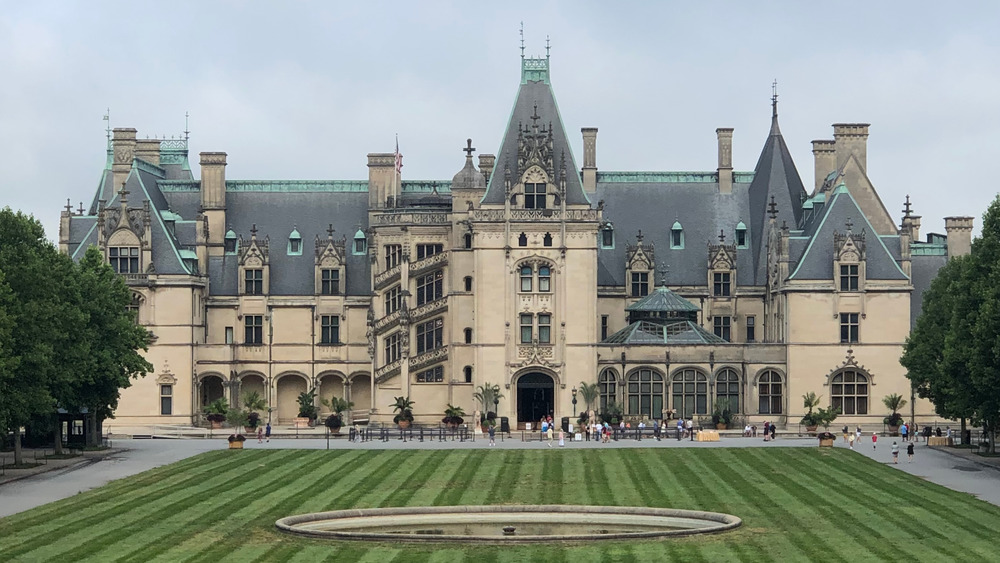
While his sis-in-laws were building some of New York City's biggest mansions, George W. Vanderbilt and his wife Edith looked to Asheville, North Carolina, to build Biltmore. Finished in 1895, the 30,000-acre manor with a 250-room French Renaissance castle took six years and cost virtually $half-dozen 1000000 to build, which would be approximately $1.six billion past today's standards, according to PocketSense. Now open to the public as a tourist attraction and national landmark, Biltmore House is considered the largest privately endemic home in the entire country and is still operated past Vanderbilt descendants today.
The Vanderbilts were more interested in philanthropy than business

Shutterstock
The Vanderbilts likewise spent quite a chip of money on philanthropy and exploring their personal interests, specially the Vanderbilts of afterwards generations. The Commodore was known to take made 1 large donation in 1873: a $ane meg gift to Nashville, Tennessee'southward, Key Academy, which would then be founded every bit Vanderbilt University, as explained past Britannica. His son, William "Billy" Vanderbilt, would continue to donate to Vanderbilt Academy and even left gifts in his will to organizations like the YMCA and the Metropolitan Museum of Fine art (via Britannica).
Three of Billy Vanderbilt'south sons were particularly known for contributing to philanthropic or cultural causes. According to Britannica, Cornelius Vanderbilt Two (not to exist confused with the Commodore's second son), who was most prominently in charge of the family investments and businesses, donated huge amounts to the Metropolitan Museum of Art, Yale University, Columbia University's College of Physicians and Surgeons. His younger blood brother, William Kissam Vanderbilt, helped manage the family business for a while just shifted control of the railroads to an outside firm in 1903. Afterwards that, he spent most of his time and money on sports and cultural causes, including yacht-racing, art-collecting, and operating the Metropolitan Opera. Finally, the youngest, George Westward. Vanderbilt, who contributed very fiddling to the Vanderbilts' investments and enterprises, would make big donations to Columbia University, the American Fine Arts Society, and the New York Public Library.
New taxes and the Bully Depression
Shutterstock
Co-ordinate to ThoughtCo, the Vanderbilts, peculiarly the Commodore, grew their wealth during an era where business regulation was practically nonexistent. By being able to monopolize entire industries, they became unimaginably rich, with no restrictions or taxes affecting their fortunes. The turn of the century, even so, saw a push for more public services, besides as a global conflict that was cutting into merchandise tariffs, as described past Heritage and ThoughtCo. Needing new revenue sources, the United states of america government formally introduced the modern estate, gift, and income taxes in the early 20th century. Suddenly, the Vanderbilts' fortunes and inheritances were cut, and their expensive lifestyles became harder to fund.
To brand matters worse, when the Swell Depression hit, the Vanderbilts had to find dissimilar ways to maintain their lifestyles and huge estates. For example, they had to open up Biltmore to the public in 1930 to "increase area tourism" and "generate income to preserve the manor" (via Biltmore's Manor History).
While other wealthy families made it through this period just fine, the Vanderbilts' excessive spending and lack of zeal toward growing their family wealth meant that the taxes and Low afflicted them much more seriously.
Alfred Vanderbilt's death on the RMS Lusitania
Hulton Annal/Getty Images
Equally documented by Geneanet, Alfred Gwynne Vanderbilt was the third son of Cornelius Vanderbilt 2 and the grandson of Billy Vanderbilt. When his begetter died of a cerebral hemorrhage, Alfred was the primary inheritor of his $72 million estate, according to The Lusitania Resource. Despite being the third-eldest son, Alfred was thought to be the 1 who would best handle the family unit fortune. His oldest brother had died young, and his second eldest, Cornelius Vanderbilt III, had been disinherited subsequently getting married without his parents' approval.
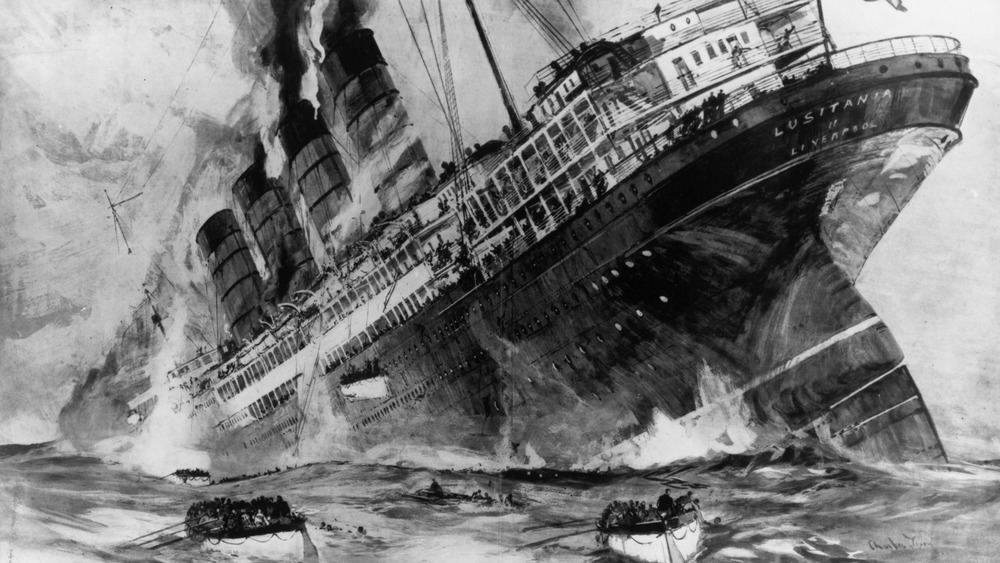
Unfortunately, at the immature historic period of 38, Alfred died every bit a passenger of the RMS Lusitania on May 7, 1915, when it was torpedoed and sunk by a German submarine during World War I. His early death meant that the family fortune was rapidly divided among his wife and immature children before it was able to grow significantly under his management, with his other brothers doing fiddling to contribute to the Vanderbilt fortune themselves after his death.
"Neily" Vanderbilt was disinherited afterwards an unapproved spousal relationship
Cornelius Vanderbilt III, Alfred Vanderbilt's older blood brother, was well-educated with iii degrees from Yale and poised to take over the family railroad business from his father. In 1896, however, at the age of 23, he decided to marry his lover Grace Wilson, a determination that his parents entirely disapproved of, according to the New Netherland Institute. Three years after his wedding ceremony, Cornelius would understand but how intensely his family had hated the union. In 1899, his father died and, out of his more than than $70 million estate, left Cornelius only $500,000. He had, in essence, been disinherited.
As described by The Lusitania Resource, most of the inheritance went to his younger brother Alfred, with his other siblings receiving $7 million each. Out of sympathy, Alfred gave him an extra $half-dozen 1000000, simply Cornelius would remain estranged from the balance of his family for decades after. On his own, Cornelius fabricated several technological developments that earned him royalties from patents and lived a lavish life. According to The Golden Age Era, Cornelius' disinheritance did not deter him or his wife from splurging on mansions, parties, yachts, and other cloth appurtenances until the early 1940s. It is articulate, though, at this point in time, that the Vanderbilt family fortune was nowhere about what it had been before.
Reginald Vanderbilt gambled away his inheritance
Apic/Getty Images
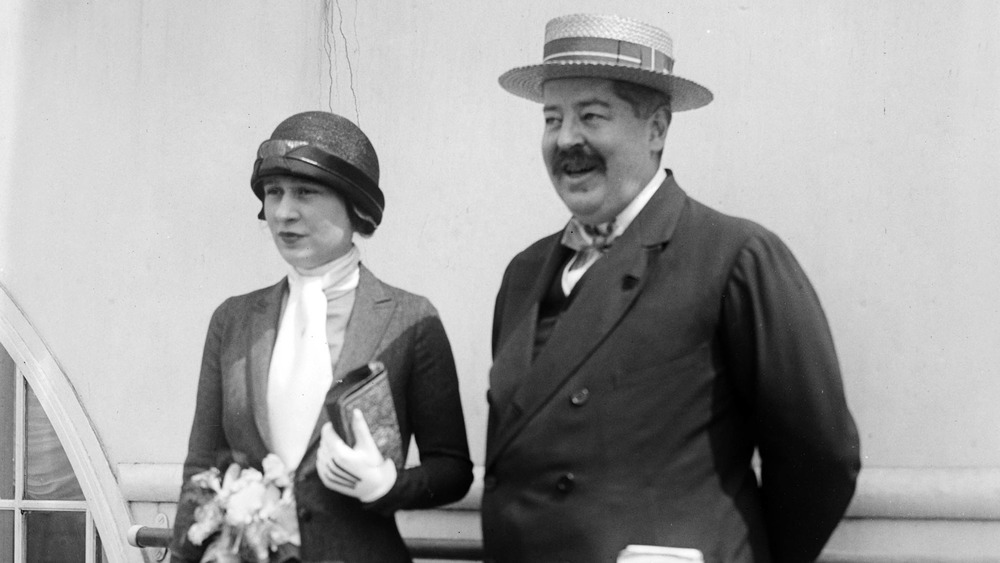
As told past Town & Country, Reginald Claypoole Vanderbilt was the great-grandson of the Commodore and the younger brother of Cornelius Vanderbilt III and Alfred Vanderbilt. As the youngest son of the family unit (per Geneanet), Reginald had little involvement in the family unit business. He contributed nothing to the Vanderbilt family fortune and instead squandered his own inheritance away on gambling and alcohol until his death.
In that location are several anecdotes that depict his reckless lifestyle. On his 21st birthday, the dark he came into his $fifteen.5 one thousand thousand inheritance, he lost $70,000 gambling. When he was 42, he was told by his doctors that he would die soon if he refused to stop his alcoholic ways. Instead, he continued and even married a 17-yr-former socialite named Gloria Morgan. Just a few years later, Reginald died from liver cirrhosis at the age of 45 in 1925. Having gambled away most of his inheritance, Reginald was broke and in debt, leaving behind a widow and infant girl who would take to live off of the interest payments of the immature girl's $v million trust fund until she was 21.
The pass up of New York Cardinal and railroads

Spencer Platt/Getty Images
While the Vanderbilt fortune was being split among more and more descendants who loved to excessively spend their inheritances, the original source of their family unit's wealth, New York Central, began to decline in the showtime half of the 20th century, co-ordinate to Forbes. Peaking in the 1920s, the ship and freight industry began to slump in the 1930s. By the finish of World State of war 2, other modes of transportation began overtaking railroads.
The family sold their shares in New York Central, and in 1954, Chesapeake and Ohio Railway'south Robert Young took over. However, diverse owners and mergers couldn't save it. New York Key went from existence the 2d-largest railroad in the United States to having its and then-current iteration get bankrupt in 1970. Throughout all of this, the Vanderbilts had failed to establish any significant businesses that would have them maintain their status equally one of America's wealthiest families.
6th-generation Vanderbilt: Anderson Cooper
Dimitrios Kambouris/Getty Images
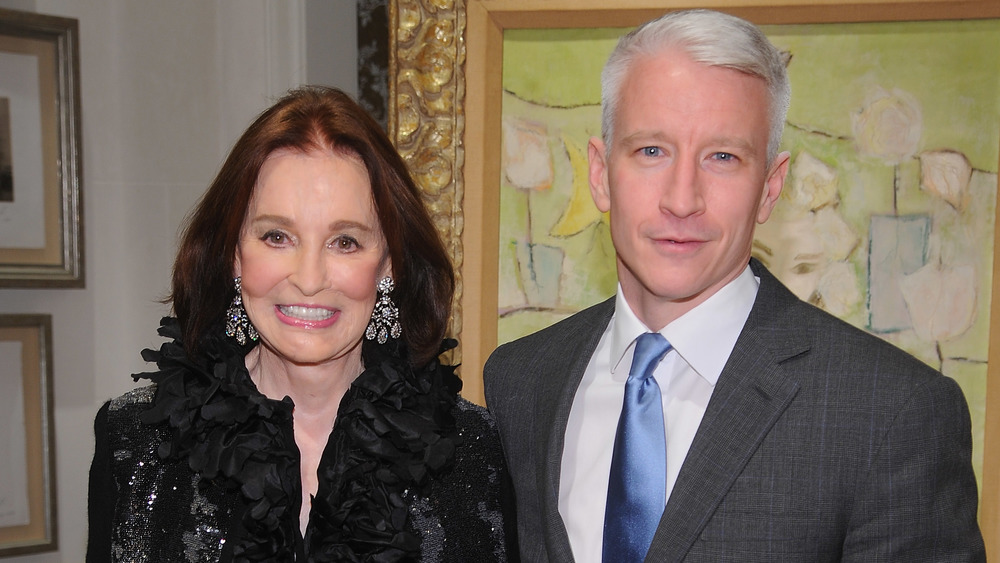
The baby daughter that Reggie Vanderbilt left behind past his death in 1925 would grow up to be fashion designer, author, artist, extra, and socialite Gloria Vanderbilt, famous for her jeans in the early 1980s. With her father expressionless and her young widowed mother something of a ghost herself, Gloria was raised by nannies in French republic knowing very little near her Vanderbilt family unit roots and the money that she was poised to inherit, according to her eulogy that was narrated by her son, via ET.
While Gloria had a publicly successful career, she made it clear to her son, news anchor Anderson Cooper, that "there's no trust fund," equally reported past the Los Angeles Times. By the late 20th century, barely 100 years after the Commodore had become the richest human being in America and his son the richest man in the earth, the Vanderbilt family unit fortune had dwindled into insignificance. When Gloria died in 2019, Cooper inherited most of her manor, which, despite existence publicly estimated to be worth $200 meg, only had a value of about $1.5 million.
bergeronskeethe1937.blogspot.com
Source: https://www.grunge.com/302542/how-the-vanderbilt-family-lost-their-entire-fortune/
0 Response to "How to Get to Michael C Rockefeller Arts Center at Fredonia College"
Publicar un comentario